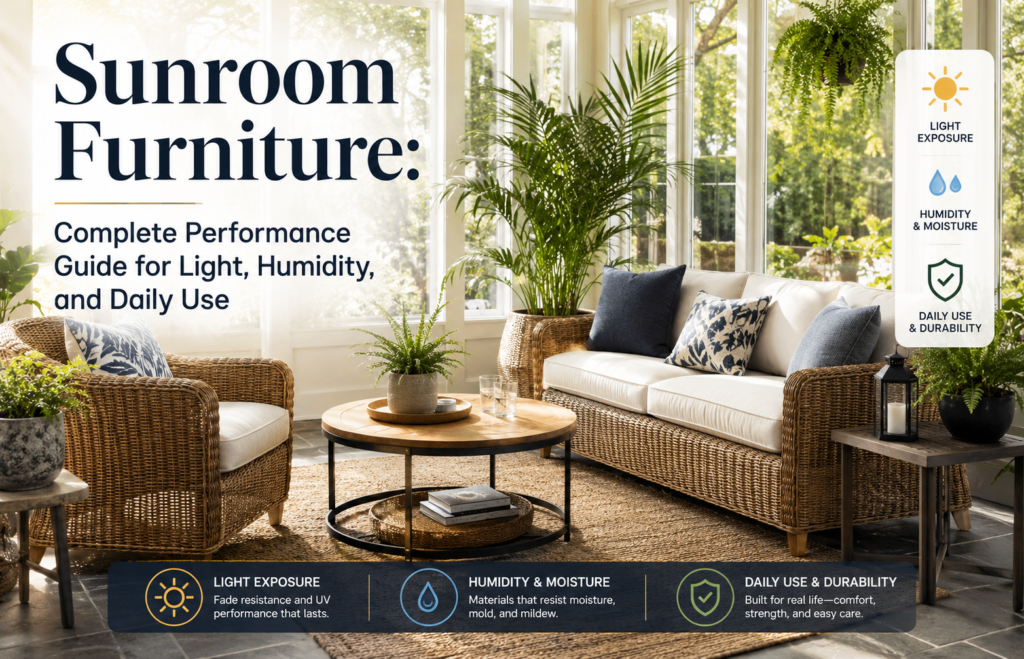
Sunroom furniture must handle direct sunlight, temperature changes, and humidity without fading, warping, or growing mold. The most reliable options are resin wicker, powder-coated aluminum, teak, and UV-resistant fabrics because they resist moisture, heat, and long-term exposure. The right choice depends on whether your sunroom is 3-season or 4-season, how much sunlight enters, and how well the space is insulated. Poor furniture selection leads to fading, cushion breakdown, and structural damage within a short time.
How Sunroom Conditions Affect Furniture Performance
Sunroom furniture performance is dictated by environmental stress, not design preference. Continuous sunlight introduces ultraviolet radiation that breaks down fabric fibers and surface coatings over time. Heat buildup near windows increases material expansion, while cooler interior zones remain stable, creating uneven stress across frames and joints. This thermal imbalance gradually weakens structural integrity, especially in rigid materials that cannot flex with temperature changes.
Humidity adds another layer of degradation. Daily moisture cycles from condensation cause cushions to absorb and release water repeatedly. This weakens foam structure, promotes mold growth, and reduces comfort over time. Furniture placed near high-exposure zones experiences faster aging compared to shaded areas, which creates uneven wear patterns across the same setup.
Key performance impacts:
- UV radiation fades fabrics and weakens material coatings
- Heat stress causes expansion and frame fatigue
- Moisture cycles degrade cushion structure
- Uneven exposure leads to inconsistent aging
How Sunroom Microclimates Affect Furniture Wear
Sunrooms do not have a uniform environment. Instead, they create microclimates where different parts of the room experience different levels of heat, sunlight, and airflow. Areas directly exposed to sunlight heat up faster and remain warmer for longer periods, while shaded zones stay cooler. This variation creates uneven stress across furniture materials, leading to inconsistent aging within the same setup. Discover in full length how a Sunroom is different is from a normal room by guiding yourself to our expert analysis on Sunroom Comprehensive Overview.
Over time, furniture placed in high-exposure zones develops faster fading, structural fatigue, and cushion degradation compared to pieces placed deeper inside the room. This is why identical furniture can age differently depending on placement. Microclimates are influenced by window orientation, airflow, and shading elements, making them one of the most overlooked factors in furniture longevity.
Microclimate impact factors:
- Window-facing zones experience higher UV and heat
- Corner areas trap humidity and reduce airflow
- Shaded areas maintain lower temperature stress
- Air circulation affects moisture evaporation rates
Microclimate Exposure Zones
| Zone Type | Exposure Level | Risk Level | Furniture Strategy |
| Window Zone | High UV + Heat | High | Use aluminum or teak |
| Mid-Zone | Moderate | Medium | Use resin wicker |
| Inner Zone | Low exposure | Low | Cushions + fabric safe |
Why Sunroom Furniture Is Different From Regular Indoor Furniture

Sunroom furniture is exposed to UV light, heat buildup, and humidity, which most indoor furniture cannot tolerate long-term.
Unlike living rooms, sunrooms behave like semi-outdoor environments. Sunlight passes through glass, intensifies heat, and slowly breaks down materials. Fabrics fade, wood expands, and foam cushions lose density faster. Furniture that performs well indoors often fails here because it is not built for continuous exposure.
This is why furniture selection must align with window exposure and insulation stability. High solar gain increases surface temperatures, while poor insulation creates moisture and temperature swings. Together, these conditions accelerate wear and reduce lifespan.
Why standard furniture fails:
- UV exposure breaks down fabric and finishes
- Heat causes expansion and material fatigue
- Humidity leads to mold, mildew, and warping
- Cushion foam degrades faster under stress
Can You Use Indoor Furniture in a Sunroom
Indoor furniture can only function properly in fully insulated, climate-controlled sunrooms. In any environment with high sunlight or humidity, indoor materials degrade quickly. Fabrics fade unevenly due to UV exposure, wood expands and contracts with temperature changes, and foam cushions lose density under repeated heat stress.
Even high-end indoor furniture is not designed for continuous environmental exposure. Within months, visible signs of damage appear, including discoloration, structural loosening, and reduced comfort. This is why indoor furniture should only be used in controlled 4-season setups where exposure levels are minimized.
Limitations of indoor furniture:
- No UV protection → rapid fading
- Poor moisture resistance → swelling and mold
- Low thermal tolerance → structural fatigue
Indoor vs Outdoor Furniture in Sunrooms (Performance Reality Check)

The difference between indoor and outdoor furniture becomes critical inside sunrooms because the environment blends both conditions. Indoor furniture is designed for stable temperatures and minimal UV exposure, while outdoor furniture is engineered for environmental stress. In sunrooms, this difference determines whether furniture lasts years or fails within months.
Outdoor furniture consistently outperforms indoor furniture in sunrooms because it is built with UV-resistant coatings, moisture-resistant materials, and flexible structures. Indoor furniture, even at premium quality, lacks these protective features. This makes it vulnerable to fading, warping, and cushion breakdown under prolonged exposure. The decision is not about comfort alone, but about how well the material tolerates environmental pressure.
Performance differences:
- Outdoor furniture resists UV and moisture
- Indoor furniture prioritizes comfort over durability
- Outdoor materials maintain structure under heat
- Indoor materials degrade faster under exposure
Indoor vs Outdoor Furniture Comparison
| Feature | Indoor Furniture | Outdoor Furniture |
| UV Resistance | Low | High |
| Moisture Resistance | Low | High |
| Heat Tolerance | Low | High |
| Lifespan in Sunroom | Short | Long |
How Sunroom Type Changes Furniture Requirements (3-Season vs 4-Season)
3-season sunrooms require outdoor-grade furniture, while 4-season sunrooms allow hybrid indoor-outdoor pieces.
3-Season Sunroom
- High humidity and temperature variation
- Exposure closer to outdoor conditions
- Risk of condensation and moisture buildup
Best fit: Weather-resistant materials like resin wicker, aluminum, and teak
Furniture selection only works when aligned with the overall sunroom environment. Without understanding how the space is designed and used, material choice becomes inconsistent.
Refer to the complete sunroom design guide to align furniture decisions with structure and exposure.
4-Season Sunroom
- Climate-controlled environment
- Stable temperature and lower humidity
- More flexibility in material choice
Best fit: Indoor-outdoor hybrid furniture with UV protection
Furniture Suitability by Sunroom Type
| Furniture Type | 3-Season Sunroom | 4-Season Sunroom | Why |
| Resin Wicker | ✅ Excellent | ✅ Excellent | Moisture + UV resistant |
| Aluminum | ✅ Excellent | ✅ Excellent | No rust, lightweight |
| Teak Wood | ✅ Excellent | ✅ Excellent | Natural oil resistance |
| Fabric Upholstery | ❌ Not Recommended | ⚠️ Conditional | Fades + absorbs moisture |
| Indoor Wood Furniture | ❌ Not Recommended | ⚠️ Conditional | Expands with humidity |
What Makes Furniture Suitable for Sunrooms
The best sunroom furniture resists UV damage, moisture, and structural movement while maintaining comfort.
Key performance criteria:
- UV Resistance
Prevents fading and fabric breakdown - Moisture Resistance
Protects against mold, mildew, and swelling - Structural Stability
Handles expansion without cracking or loosening - Cushion Durability
High-density foam retains shape longer - Low Maintenance
Easy cleaning and long-term usability

Best Materials for Sunroom Furniture (Performance-Based)
Resin Wicker
Best overall for durability and aesthetics
- Synthetic material designed for outdoor conditions
- Does not absorb moisture
- Resistant to UV fading
Powder-Coated Aluminum
Best for lightweight, modern setups
- Rust-proof and corrosion-resistant
- Handles temperature changes well
- Easy to move and maintain
Teak Wood
Best natural material option
- Contains natural oils that resist moisture
- Highly durable over decades
- Develops a natural patina over time
Outdoor Fabric (Solution-Dyed Acrylic)
Best for cushions and upholstery
- UV-resistant fibers prevent fading
- Quick-drying and mold-resistant
- Maintains color under sunlight
Engineered Wood (Limited Use)
Only for controlled environments
- Works in insulated 4-season sunrooms
- Sensitive to humidity and sunlight
- Requires stable conditions
Furniture Materials to Avoid in Sunrooms
Some materials fail quickly under sunroom conditions regardless of quality.
- Solid indoor wood (warps and cracks)
- Low-quality foam cushions (flatten quickly)
- Untreated fabric (fades and absorbs moisture)
- Steel frames without coating (rust risk)
What Furniture Works Best in a Sunroom and Why
Furniture that performs best in a sunroom is engineered to handle outdoor-level exposure while maintaining indoor comfort. Materials like resin wicker, aluminum, and teak are designed to resist UV degradation, moisture absorption, and structural movement. Unlike indoor furniture, these materials maintain their form and appearance despite constant environmental stress.
The reason these materials outperform others is their ability to balance flexibility and durability. Resin wicker adapts to temperature changes without cracking, aluminum resists corrosion and heat stress, and teak contains natural oils that prevent moisture damage. This makes them reliable in both 3-season and 4-season environments where conditions fluctuate.
Material Performance Matrix
| Material | UV Resistance | Moisture Resistance | Maintenance | Lifespan |
| Resin Wicker | High | High | Low | 10–15 yrs |
| Aluminum | Very High | Very High | Low | 15–20 yrs |
| Teak | High | High | Medium | 20+ yrs |
| Fabric Upholstery | Low | Low | High | 3–7 yrs |
Best-performing traits:
- UV stability for long-term color retention
- Moisture resistance to prevent mold
- Structural flexibility under heat
- Low maintenance requirements
What Is the Best Cushion Type for Sunroom Furniture

High-performance cushions are essential for maintaining comfort and durability in sunroom environments. The best option combines high-density foam with solution-dyed acrylic fabric. This combination resists moisture absorption, prevents UV fading, and maintains structural integrity under repeated heat exposure.
Foam density plays a critical role in long-term performance. Low-density foam compresses quickly and loses shape, while higher-density foam retains support over time. Fabric selection is equally important. Acrylic fabrics outperform polyester by resisting UV damage and moisture buildup, reducing the risk of mold and discoloration.
Cushion performance factors:
- Foam density: 1.8 lbs (basic) vs 2.5+ lbs (high durability)
- Quick-dry foam prevents moisture retention
- Acrylic fabric resists UV fading
- Mold resistance ensures long-term usability
Sunlight and Window Exposure Impact on Furniture
Large windows increase UV exposure, which accelerates fading and material breakdown.
Furniture placed near windows experiences:
- Higher surface temperatures
- Faster color fading
- Uneven wear patterns
UV damage is not uniform. Areas exposed to sunlight fade, while shaded areas retain color. Over time, this creates visible contrast that cannot be reversed.
Furniture placement must consider window orientation and exposure levels.
The level of UV exposure depends entirely on your window system. Glass type and coatings control how much sunlight enters the room.
See sunroom window performance and glazing options to understand how furniture exposure is affected.
How Insulation Affects Furniture Lifespan
Insulation stabilizes temperature and reduces moisture fluctuations, protecting furniture materials.
Well-insulated sunrooms:
- Reduce humidity buildup
- Maintain consistent temperature
- Extend cushion and material lifespan
Poor insulation creates a cycle of expansion, contraction, and moisture exposure, which accelerates damage.
Furniture lifespan is strongly influenced by temperature stability. Insulation reduces stress caused by expansion and humidity changes.
Learn how sunroom insulation systems stabilize indoor conditions and protect furniture.
How Long Does Sunroom Furniture Last
Sunroom furniture lifespan varies based on material quality, environmental exposure, and maintenance practices. High-performance materials such as aluminum and teak can last over two decades, while fabric-heavy or low-quality furniture may degrade within a few years under constant sunlight and humidity.
Exposure levels directly affect durability. Furniture placed near windows experiences faster wear due to higher UV intensity and heat concentration. Proper placement, rotation, and material selection significantly extend lifespan and reduce replacement frequency.
Average lifespan range:
- Aluminum: 15–20+ years
- Teak: 20+ years
- Resin wicker: 10–15 years
- Fabric-heavy furniture: 3–7 years
Cost of Sunroom Furniture (Material-Based)
| Furniture Type | Avg Cost Range | Lifespan | Maintenance Level | Value |
| Resin Wicker | $300–$2,000 | 10–15 yrs | Low | High |
| Aluminum | $200–$1,500 | 10–20 yrs | Low | High |
| Teak Wood | $800–$3,000+ | 20+ yrs | Medium | Very High |
| Fabric Upholstery | $100–$800 | 3–7 yrs | High | Low–Medium |
How to Arrange Furniture in a Sunroom Without Damage

Furniture arrangement plays a critical role in preventing uneven wear and extending lifespan. Sunrooms create exposure zones where areas near windows receive intense sunlight and heat, while interior zones remain cooler. Placing sensitive materials in high-exposure areas leads to faster degradation and visible damage.
Strategic placement reduces stress on materials and balances wear across the setup. Durable materials should be positioned near windows, while cushions and fabric-heavy furniture should be placed in lower exposure zones. Periodic rotation further prevents uneven fading and structural fatigue.
Smart placement strategy:
- Place UV-resistant materials near windows
- Keep cushions away from direct sunlight
- Rotate furniture every few months
- Use rugs or shades to reduce heat concentration
Seasonal Stress Cycle: Why Furniture Fails Over Time
Sunroom furniture does not fail instantly. It fails through repeated seasonal stress cycles. During summer, high temperatures and intense sunlight expand materials and weaken fabrics. In winter, cooler temperatures cause contraction and increase surface rigidity. This repeated expansion and contraction gradually breaks down structural integrity.
Humidity adds another layer of stress. In warmer months, moisture levels rise, causing cushions to absorb water and materials to expand. In cooler months, drying cycles cause contraction and stiffness. This continuous cycle weakens joints, reduces cushion resilience, and accelerates material fatigue. Understanding this process explains why furniture that looks fine initially begins to degrade after one or two seasonal cycles.
Seasonal stress effects:
- Expansion in summer weakens joints
- Contraction in winter creates structural tension
- Moisture cycles damage cushions and fabrics
- Repeated cycles reduce overall lifespan
Seasonal Stress Impact
| Season | Stress Type | Impact on Furniture |
| Summer | Heat + UV | Expansion, fading |
| Winter | Cold | Contraction, stiffness |
| Humid Periods | Moisture | Mold risk, cushion damage |
Common Sunroom Furniture Mistakes
Most furniture failures are caused by incorrect material selection and placement.
- Using indoor furniture in high-humidity sunrooms
- Ignoring UV exposure near windows
- Choosing low-density cushion foam
- Placing furniture directly in high heat zones
- Not rotating furniture to prevent uneven fading
A common real-world issue occurs when indoor sofas are placed near sunroom windows. Within months, the fabric fades unevenly, and the foam begins to lose shape due to heat exposure. This happens even in high-quality furniture because it is not designed for continuous UV stress.
Failure Risk Table
| Mistake | Result | Timeframe |
| Indoor furniture in sunroom | Warping and fading | 6–12 months |
| Low-quality cushions | Flattening and discomfort | 3–9 months |
| No UV protection | Color fading | 6–18 months |
| Poor placement near windows | Uneven wear | 3–12 months |
Expert Checklist: How to Choose Sunroom Furniture

- Evaluate sunlight intensity and window placement
- Identify humidity level (3-season vs 4-season)
- Choose weather-resistant materials
- Prioritize cushion quality and UV resistance
- Balance budget with long-term durability
Quick Decision Table
| Condition | Best Choice |
| High sunlight | Resin wicker or aluminum |
| High humidity | Resin wicker |
| Luxury durability | Teak wood |
| Budget option | Aluminum |
| Cushion-heavy setup | UV-resistant outdoor fabric |
FAQs
What is the best furniture for a sunroom with lots of sunlight?
Resin wicker and aluminum furniture perform best because they resist UV damage and heat.
Can you use indoor furniture in a sunroom?
Only in fully insulated 4-season sunrooms. Otherwise, it will fade and degrade quickly.
What fabric is best for sunroom cushions?
Solution-dyed acrylic fabrics are best because they resist fading and moisture.
Does sunroom furniture fade over time?
Yes, especially without UV-resistant materials. Sunlight gradually breaks down color pigments.
How long does sunroom furniture last?
High-quality materials like teak or aluminum can last 10–20+ years, while low-quality options fail much sooner.